DevOps Fundamentals: Complete Introductory Guide for Starters

Software engineer specializing in cloud technologies, focused on streamlining operations and enhancing software delivery through automation and continuous integration. Dedicated to driving innovation and efficiency in tech environments.
What is DevOps?
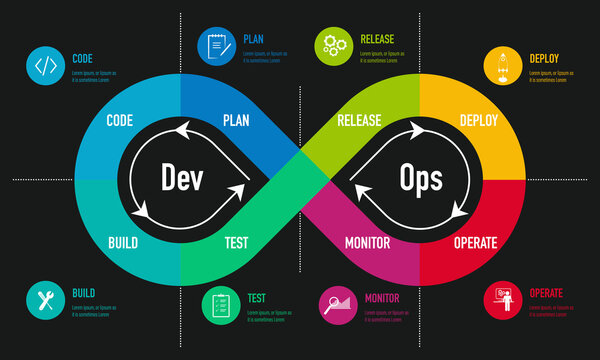
DevOps is a set of practices and cultural designed to improve collaboration and communication between software development (Dev) and IT operations (Ops) teams. It focuses on automating and streamlining the processes of building, testing, deploying, and operating software applications and systems. The goal of DevOps is to shorten the development lifecycle, deliver software releases more frequently, and improve the reliability, security, and scalability of software systems.
Key aspects of DevOps include:
Automation: Using tools and scripts to automate manual tasks such as building, testing, and deployment, reducing human error and increasing efficiency.
Continuous Integration and Continuous Delivery (CI/CD): Practices that involve continuously integrating code changes into a shared repository, and then automatically testing and delivering those changes into production environments.
Infrastructure as Code (IaC): Managing and provisioning infrastructure (such as servers, networks, and databases) through code and automation tools, ensuring consistency and scalability.
Monitoring and Logging: Continuous monitoring of applications and infrastructure to detect and respond to issues proactively, and logging events to analyze system behavior and performance.
Collaboration and Communication: Encouraging collaboration and communication between development, operations, and other stakeholders throughout the software delivery lifecycle, fostering a culture of shared responsibility and continuous improvement.
Lean and Agile Principles: Embracing lean and agile methodologies to promote rapid and iterative development, customer feedback, and continuous improvement.
DevOps is not just about tools and automation; it also emphasizes cultural transformation and a mindset shift towards shared goals, transparency, and accountability. Organizations adopting DevOps practices typically experience faster time to market, improved deployment frequency, lower failure rate of new releases, and shortened lead time between fixes.
Why DevOps?
Before DevOps, delivering applications required multiple teams and a lot of manual work, making the process slow. DevOps emerged to make application delivery more efficient.
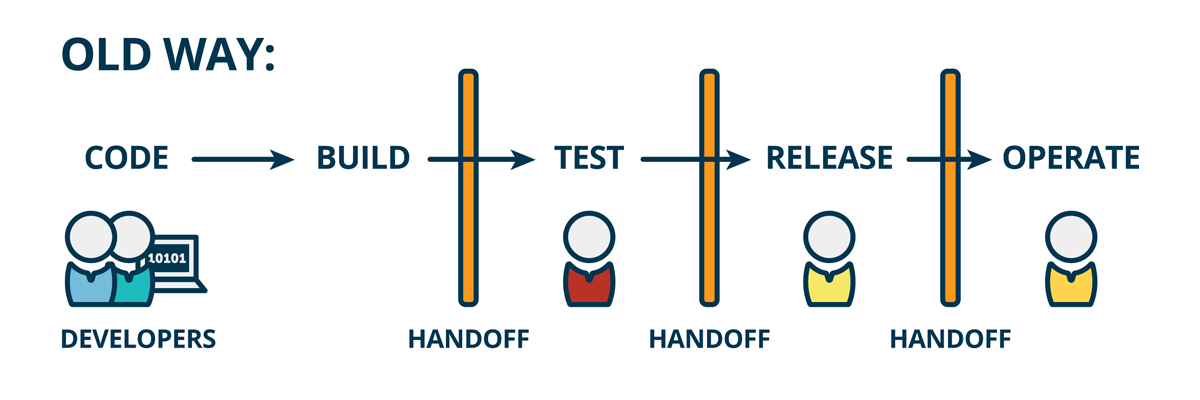
The developer-build-test-release-operate process often followed a sequential and manual approach:
Developer: Developers would write code and manually compile/build their applications.
Build: Once code was written, a designated build team or individual would manually initiate the build process to create executable software from the source code.
Test: Testing was typically done by a separate QA team, who would manually test the software against predefined test cases to identify bugs and issues.
Release: After testing, the software would be handed over to operations or deployment teams, who would then manually release the software to production environments.
Operate: Once in production, operations teams would manage and monitor the software, manually addressing any issues that arose and ensuring its continued performance and availability.
Each of these steps was often executed independently and in sequence, leading to potential delays and miscommunications between teams. DevOps practices aim to automate and integrate these processes to enable faster and more reliable software delivery and operation.
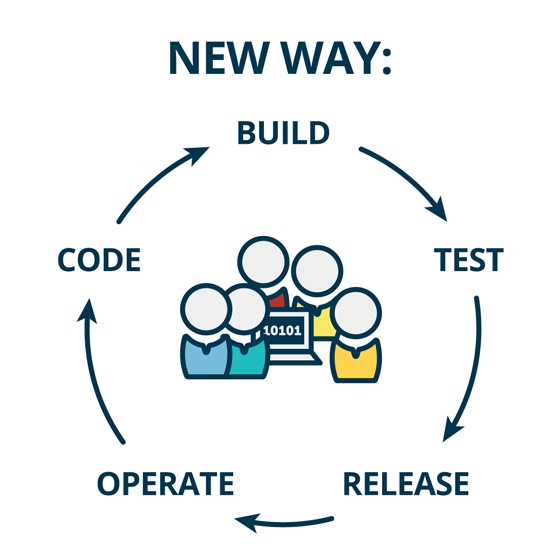
After adopting DevOps, the developer-build-test-release-operate process undergoes significant improvements and transformations:
Developer: Developers work in collaboration with operations and other teams, focusing on writing code that is modular, scalable, and easier to integrate. They use version control systems and automated testing frameworks to ensure code quality from the start.
Build: Automation tools and continuous integration pipelines are used to automatically build applications whenever new code is committed. This ensures that builds are consistent and reliable, reducing manual errors and accelerating the development cycle.
Test: Automated testing practices, including unit tests, integration tests, and acceptance tests, are integrated into the CI/CD pipeline. This allows for quick feedback on code changes and ensures that defects are identified and fixed early in the development process.
Release: Continuous Delivery (CD) pipelines automate the deployment process, allowing teams to release software updates to production environments quickly and frequently. This reduces the time-to-market for new features and enhancements.
Operate: Operations teams leverage infrastructure as code (IaC) and automated configuration management tools to provision, manage, and scale infrastructure resources dynamically. Continuous monitoring and logging provide visibility into application performance and health, enabling proactive troubleshooting and optimization.
Feedback Loop: Continuous monitoring and user feedback loops provide valuable insights into application usage and performance in real-time. This data informs future development cycles and helps prioritize improvements based on user needs and business objectives.
Collaboration and Continuous Improvement: DevOps fosters a culture of collaboration, transparency, and shared responsibility across development, operations, and other teams. Regular retrospectives and post-mortems encourage continuous improvement and learning from both successes and failures.
In essence, DevOps transforms the developer-build-test-release-operate process into a streamlined, automated, and collaborative approach that enables organizations to deliver high-quality software faster, more reliably, and with greater agility.